

Recent news and events
Detroit Lake drawdown schedule and timeline
Judge declines to halt the drawdown; Marion County to appeal
U.S. District Judge Mustafa T. Kasubhai denied the requests from Marion County and Salem for a preliminary injunction. He found they had shown that harm to drinking water and other uses was possible, but not that it was likely, which is the standard for pausing the operation. The denial is without prejudice, so the request can be renewed if new evidence emerges, including during this year's drawdown. The ruling does not decide the underlying lawsuits, which remain pending. Marion County said the same day that it would appeal to the Ninth Circuit Court of Appeals and ask for an emergency injunction while the appeal is heard. The Corps has not announced a start date.
Read the KATU report on the rulingRead Marion County's statement on its appeal
Federal judge hears the injunction request
U.S. District Judge Mustafa T. Kasubhai heard arguments in Eugene from Marion County, Salem, Stayton and the Santiam Water Control District, who want the drawdown paused while the lawsuit is decided, and from the Corps, which says the Endangered Species Act requires it. The judge took the request under advisement and said he expected to rule by the end of October; he also asked the Corps to notify the court if it intends to begin the drawdown before November 1. The ruling came on November 4.
Salem files motion for a preliminary injunction
Salem asks the federal court to prevent the Corps from beginning a deep drawdown while the lawsuit is decided. As an alternative, the City asks the court to require the Corps to stop a drawdown below 1,450 feet if turbidity reaches 10 NTU and not resume until it falls below that level. The motion argues that mobilized sediment could damage Salem's slow-sand filters and threaten drinking-water service for approximately 220,000 residents and critical facilities. These are Salem's allegations and requested remedies. The court denied the motion on November 4, 2026.
Salem seeks to halt the planned operation
Salem's legal complaint challenges the Detroit Reservoir deep drawdown and describes concerns involving sediment, turbidity, and drinking-water treatment.
Corps describes timing and target levels
The Corps says the start will depend on forecasts after November 1. Its published explanation describes a gradual lowering toward 1,425 feet, a holding period, and subsequent refill.
The plan in plain language
What is a deep drawdown?
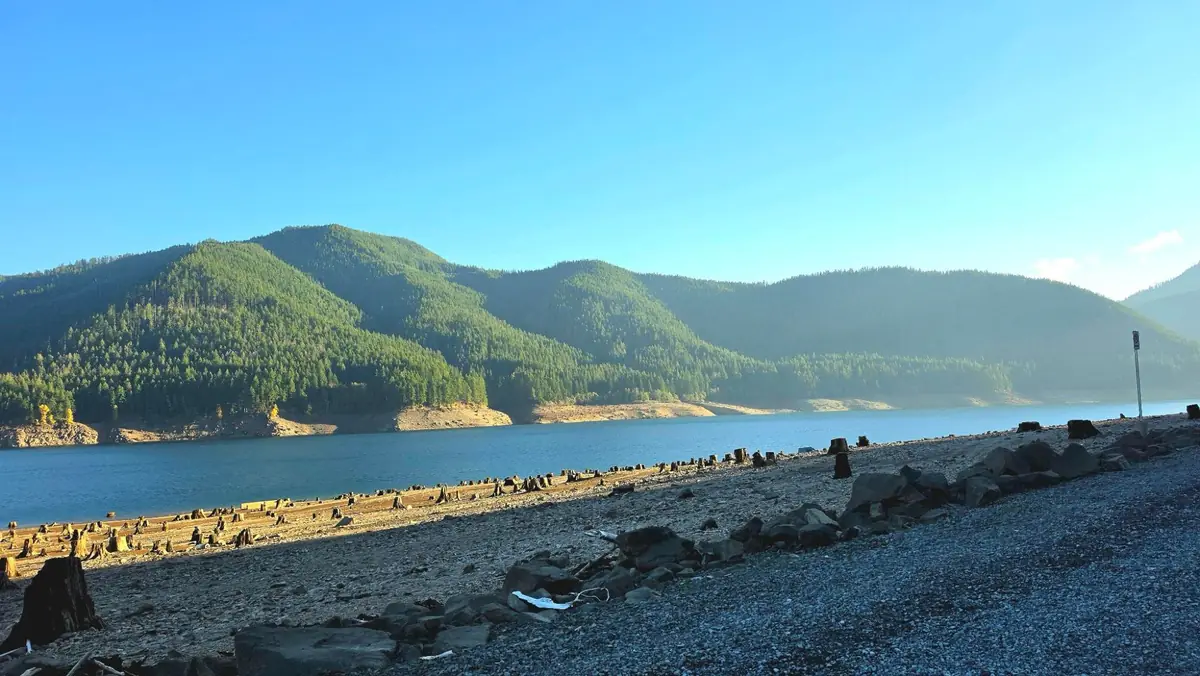
A drawdown lowers a reservoir by releasing more water than enters it. For Detroit Lake, the proposed operation would lower the reservoir substantially below ordinary seasonal levels so juvenile fish can move through lower dam outlets. The change may also mobilize sediment that has accumulated behind the dam.
Fish objective
Improve downstream passage for threatened Upper Willamette River Chinook salmon and other fish.
Sediment concern
Lower water may expose and move reservoir sediment, increasing turbidity downstream.
Drinking water
Downstream communities are evaluating whether additional sediment could complicate source-water treatment.
Lake and recreation
Boat access, shoreline conditions, fishing, and local travel may change as reservoir elevation falls.
Could the lawsuit stop the drawdown?
It has not so far. A court can pause government action through preliminary relief while a case proceeds, and on November 4, 2026 the judge declined to do that here. Three things could still change the picture: Marion County's appeal to the Ninth Circuit and its request for an emergency injunction, a renewed request to the district court if new evidence emerges during the drawdown, and the underlying lawsuits, which have not been decided. Until a court orders otherwise or the Corps changes its schedule, treat the drawdown as going ahead.
Related searches
Detroit Lake drawdown questions
Is the Detroit Lake drawdown happening in 2026?
The U.S. Army Corps of Engineers has announced a 2026 operating plan with a start selected after November 1 based on forecast conditions. On November 4, 2026, a federal judge declined to halt it, which leaves the Corps free to proceed. Marion County says it will appeal, and the Corps has not yet announced a start date.
What is the Detroit Lake drawdown schedule for 2026?
The U.S. Army Corps of Engineers has set a drawdown window of November 1 to December 31, 2026, with the start date chosen from forecast conditions after November 1. The Corps expects it to take about two weeks to lower the reservoir to 1,425 feet, followed by about two weeks at that level before the lake begins to refill. The Corps has not announced a start date, and an appeal by Marion County could still affect the schedule.
What is the Detroit Lake water level today?
The latest provisional Detroit Lake elevation is available from the USGS gauge linked on this page and in the live conditions panel on the Santiam Silt homepage.
Why is Detroit Lake being drawn down?
The Corps says the lower reservoir operation is intended to improve downstream fish passage, including passage for threatened Upper Willamette River Chinook salmon.
Could litigation stop the Detroit Lake drawdown?
It has not so far. On November 4, 2026, U.S. District Judge Mustafa T. Kasubhai denied the requests from Salem and Marion County to pause the drawdown, finding the harm they fear was possible but not shown to be likely. The request can be renewed with new evidence, Marion County says it will appeal to the Ninth Circuit, and the underlying lawsuits are still pending.